Friday, June 13, 2014

RIP: Steve

I've been working on a portrait essay for a few years now on veterans. All services, all ranks, all wars. 

I guess it's been four years now but my friend Jen had me over at her flat to do portraits of her and some of her friends. This is when I met Steve. 

Steve Robinson was a retired Ranger. Was with 10th Special Forces. Very low key. Very humble. Supremely confident. 

I made two portraits of Steve that day. A simple shot of him wearing a baseball cap. Another of him where he wanted to send a message. 


They've always been two of my favorites but now there's a vibe about them. I found out last night, shortly before passing out from exhaustion, Steve passed last week. The veteran's community has lost a great voice. None of the things Steve did for other vets was about Steve. It was always about helping other vets come home, or at least get as close as they could to it. He lived and breathed that cause. 

We talked a few times a year. Sometimes in person but mostly short phone calls or emails. He helped me more than I could admit. He talked me back from the figurative ledge a couple of times and was extremely supportive of my trips to Afghanistan. 

Now that he's passed the vibe of quiet motivation and support has turned to mourning. I'll miss Steve.

#RIP #deOppressoLiber #Veteran

Wednesday, May 07, 2014

A bit of street photography

The art of street photography is zen and nerve wracking. Simultaneously. 

I like the anonymity of street photography. There's a rush of capturing truly unguarded moments in a person's life. You'll likely never meet but you're capturing something about them. I don't get up in their personal space. There's no forcing each other to interact. It just is. But it's nerve wracking because each person's reaction to a shutter's clickity clack will be different.

I made these a couple of weeks ago running errands in the district.


Thursday, May 01, 2014

Soviet lens test

A few years ago I bought a used Soviet medium format camera. I still have it but haven't really don't much with it. Sure, I took it out occasionally but nothing major. Not trips with me to Iraq or Afghanistan. It was used toying around at parties or even out on the street. 

Flowers in my front yard, April 19, 2014.

Soviet cameras had a much deserved reputation for clunky mechanics, bad form or general unreliability. The optics weren't any better. My first Soviet-built camera was a bad Leica/Contax copy. I might've used it for a year or two and a dozen rolls of Tri-X, then chucked it. 

I like medium format. The size of the negs. How the cameras, especially this one in particular, feel in my hand. This one isn't like my other cameras where the shutter button is on the right. This one is on the left. Until a couple of weeks ago I had no way to shoot this lens digitally. The lenses are made with a Pentacan mount originally developed in East Germany and copied in the Soviet Union. I found a Pentacon-to-Canon EF adapter at Fotodiox and ordered it. 

I really lucked out with this camera and lens set. This camera is a beauty. The optics are great. And here's proof. I shot this in my front yard. The lens is a ВЕГА-12б (Vega-12b) 90mm f2.8. 

I plan on shooting with this bad boy a lot more. 


Wednesday, April 23, 2014

Three years

It's crazy Chris has been gone three years. 

I met Chris via email right as I was headed home from Baghdad in 2005. He had finished up an embed with Division and someone had given him a ride to the gate. His helmet was still in the Humvee. Brent, another Getty shooter in country, was there and gave me Chris' email and I let him know. 

Chris got back to me a couple of hours later. We stayed in touch. Crossed paths during my freelance days over there. I finally met him in person at Eddie Adams in 2006. He asked if I was headed back over. We kept in touch.

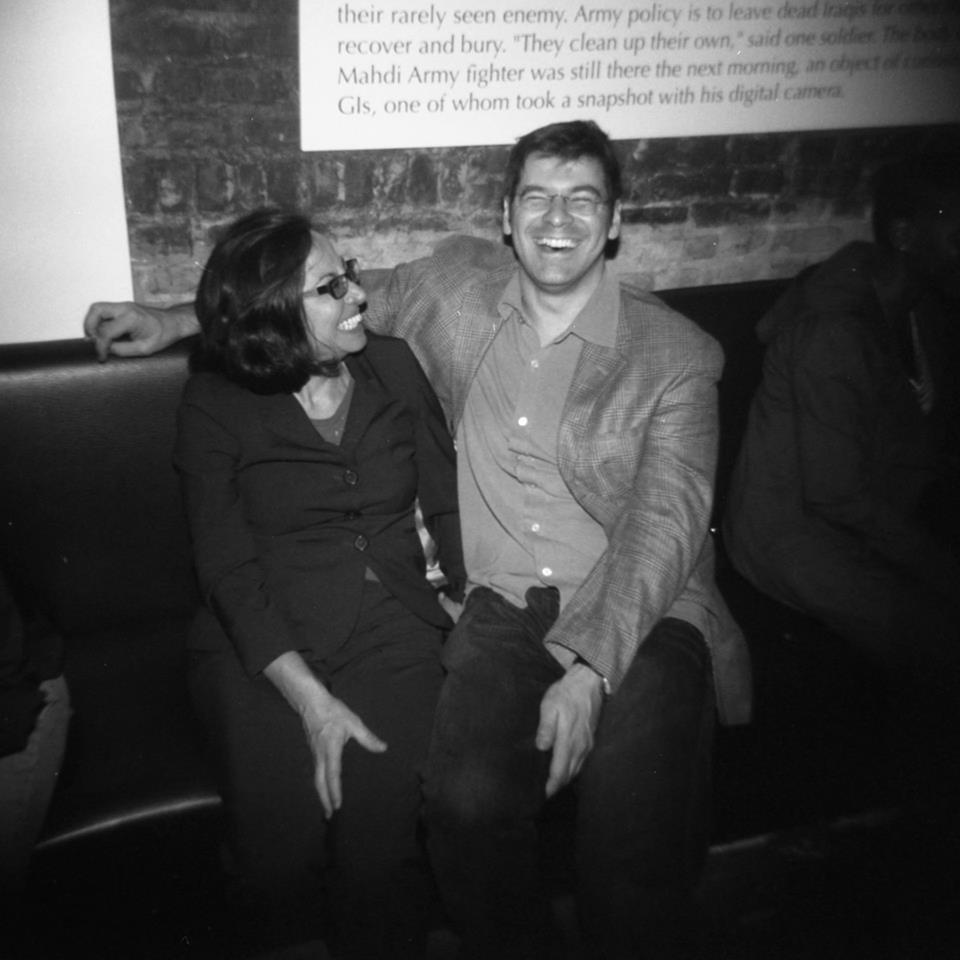
The last time I can remember seeing him was at a book launch party in New York. The photo below is him at that party. It shows Chris for who he was, fun. At least I hope it does. 

I met his fiance, Christina a few weeks after he was buried at the Conflict Zone opening here in DC. The little contact I had with Chris meant a lot. He encouraged me. Liked me work. Christina has this photo now. 


But I'm writing because of the video below, not to remember short meetings or partying with him. Single moments can define our lives. Single moments are what photojournalists work for. Did you get it or not? Is it in focus? Exposed properly?  For all of his beautiful work, Chris will, right or wrong, be remembered for this photo from Tal Afar, Iraq. Here's a video from Time.com about that image.

Monday, April 14, 2014

Safety in extreme environments vs. working to death.

This is a tragedy. I'd read Matt's work from time to time and thought it great. I've also met other scribblers and snappers like him, always on the go go go. Eventually, as we learned in his case, it can kill you. For what? Why did he have to die? Why didn't he (or couldn't he) take a couple of days to acclimate? Was it about money? 

When Don and I were heading to Paktika the summer of 2010 we purposely built in a fairly long lead time. Once we arrived in Afghanistan it took us about five days of traveling and waiting with stops at KAIA, Salerno, Orgun-E and finally Bermel. Altitude increased at every stop, save one at Salerno where it went down from roughly 5,200 feet at KAIA to 3,800 feet there. The highest elevation en route was at Orgun-E, which, I think was at 7,800 feet. Bermel was a bit lower at around 7,500 feet. 

We spent three days at Salerno diddy bopping around trying to acclimate to higher altitudes. I was coming from The WDC, Don from Fort Worth. By the time we got to Bermel and Abu Company we were sort of used to the altitude. I mean sort of in a very generous context. Because of the issues associated with higher elevations we declined to go on an op. There was just no way in hell it would have been safe for anyone if we'd gone up there so shortly after arriving. 

Eventually we acclimated and we went out. Our deadline was also incredibly liberal. So loose, in fact, most of my stills folio was shot on film. I imagine Matt was working under similar deadlines as a magazine writer. 

My point is this is about safety. For everyone. Is safety worth the money his editors potentially saved because he rushed out there? Nope. Not to me. But then again, maybe that's why those Go Go Go Scibblers and Snappers are generally more successful than me. I'll take my long-term health and life though.

Wednesday, April 09, 2014

A triptych of Lashkar Gah


Kids, thousands of them, were headed home after school. 

I didn't really get to hang out with Afghans beyond our linguists, a few police officers, and soldiers. That still disappoints me, but I take what cards I'm dealt and try to work them in my favor. 

The only advantage I had was making photos during my drives through Lash or other places. This triptych was made almost two years ago during one of my first drives through the tired, dusty, and hot capital of Helmand. 

Beyond the there and then during those drives, I didn't think much. It was only after getting back to my office on Leatherneck or even back home to The World, after the photos had time to breath, when I started to slowly unwrap what I'd seen and experienced out there. 

I read somewhere last week before the Afghan presidential elections (that might or might not have gone off smoothly) that 64 percent of that country's nearly 32 million people is under 24 years old. Think about that for a minute, a majority of it's citizens have grown up during this current war. Which made me think about the Afghans I saw through the greenish haze of bullet proof glass. 

Those drives weren't as stressful as driving through the anarchy that was Baghdad or the simmering hell that was Bayji or walking around Bermel, Paktika. The stress was just low key. Outside those windows was the daily normal of daily life around the world. Kids go to school. They play. The sometimes stare at lumbering 20-something-ton vehicles of foreign militaries. Or they ignore those lumbering vehicles and the people inside them. 

Driving through Lash

I looked out of the MRAP into a pile of men and boys in the bed of that pick up. Holding on for dear life as it sped past us. Holding on for dear life. Thinking about that now almost two years later seems to be the perfect metaphor, really, for the Afghan civilians. 


I banged out a few frames from my vantage point and sat back to chimp. 

These photos were made almost two years ago today whilst driving through Lashkar Gah, the capital of Helmand province, Afghanistan. I spent quite a bit of time down there based out of MOB Lash, the main British Forces camp in the area, or Laskar Gah Training Centre, the training site for all Afghan National Police in Helmand and Nimrouz provinces. 

The only way, really, to get to The LTC was a combination of flying to MOB Lash and catching a ride. Most often it was with an American Army unit attached to my unit or sometimes with a British Army unit headed that way. It wasn't a long drive by distance but took forever to drive through Lash in the back of giant MRAP vehicles. Driving afforded me my only real contact with Afghans down there. 

The metallic ping of rocks thrown by kids hitting the vehicles was the common greeting. Some adults would wave. Others would flip us off. The rest just stared, that hard stare I'd seen other places that only seemed to get harder the further east I've been. Lash is mostly a poor town. Very monotone. There are a few "poppy palaces," houses owned by alleged drug smugglers clustered in one area near the bazaar. But mostly it was mud squats, qalats. Dirty roads. Beat up old cars and pickups. The green water of the Helmand River coursing north to south through town. 

This particular drive was one of my first and, I think, we were headed back to MOB Lash to catch a flight. Like all of my rides during those 16 months it was completely absent of bang bang. The vibe, as the Squaddies told me, was  mostly "low key." 

I banged out those few frames and saw the girl in my camera's LCD, blurry and barely visible. Western men rarely ever see uncovered faces of Afghan women. Afghan girls, sure, but almost never women. I had one here. It was like seeing a ghost and I knew I'd never see another.